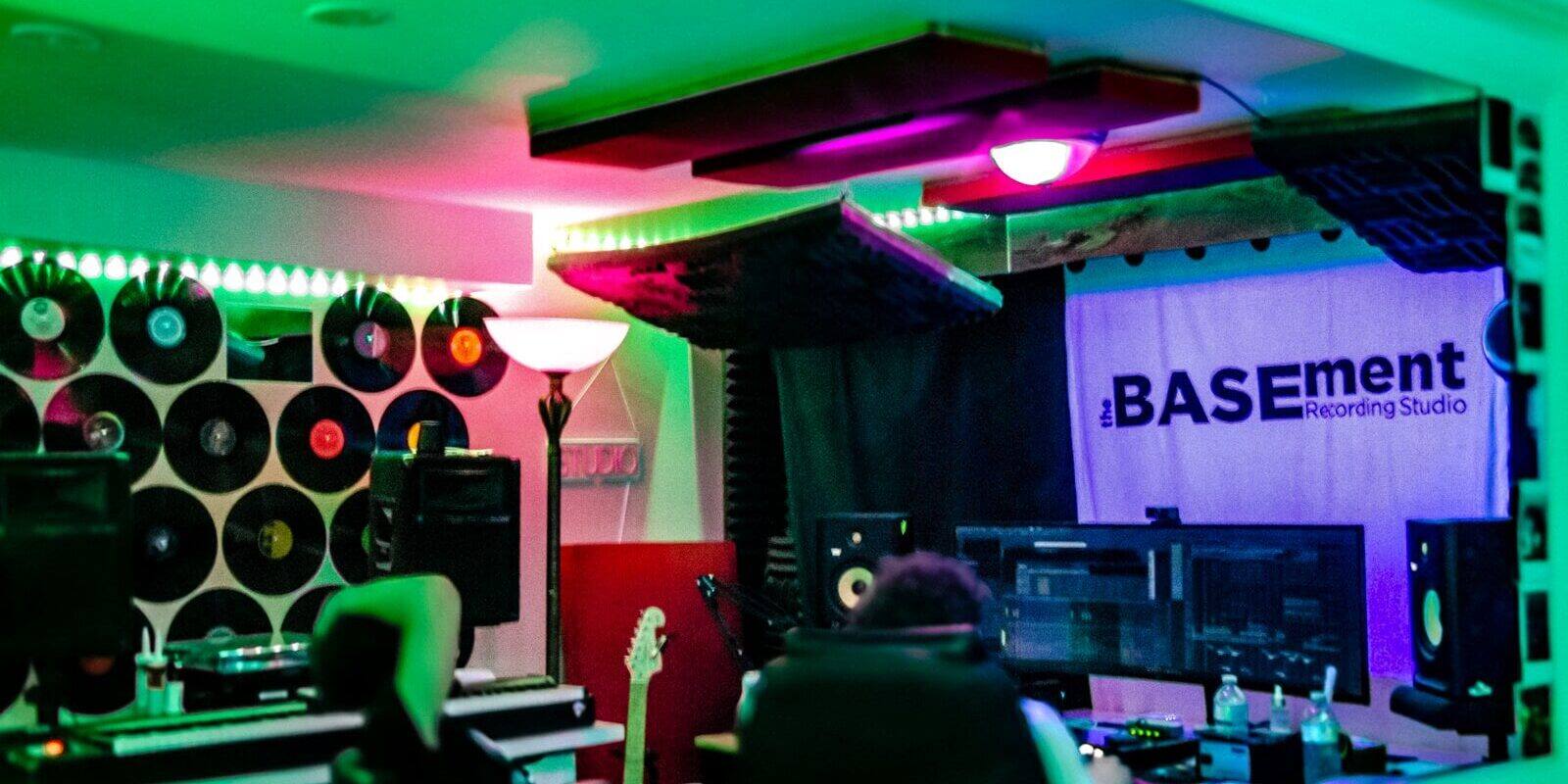
There is no single best recording studio in Toronto, and any studio that tells you otherwise is selling. There is a best studio for your song, your budget and your deadline — and the difference between the right room and the wrong one is usually decided by seven questions you can ask before you spend anything.
Here is the checklist, why each item actually matters, and how we answer it.
The short version
The BASEment is a recording studio at 23 Alexis Blvd in North York, Toronto. Sessions run $55–$70/hr with an engineer included, one hour minimum, in a treated room open from noon until 2 AM every day except Wednesday. Recording, production, mixing, mastering, podcasts and voice-over all happen in the same room, with the same engineer, on Pro Tools, FL Studio and Ableton Live.
If you only ask one question of any studio, make it question one below.
1. Is an engineer included, or are you renting a room?
This is the biggest hidden variable in studio pricing in this city, and almost nobody advertises which side of it they are on.
A room-only rate means you are renting a space. You bring your own engineer or you drive the session yourself. An engineered rate means someone experienced is sitting beside you, and their ear is most of what you are paying for. Those two numbers are not comparable, and the room-only one will always look cheaper.
Every session here is engineered hands-on. The engineer picks the mic, sets the gain, builds your headphone mix, punches you in and comps as you go. There is no separate operator fee and no dry-hire tier where you get left alone with the gear.
2. Is the room treated, or is there foam on the wall?
Acoustic treatment is the one thing you cannot fix in the mix, and it is the single largest difference between a recording that sounds professional and one that sounds like a bedroom.
Foam panels are not treatment. Foam absorbs high frequencies and does close to nothing about the low-end reflections that actually make a vocal sound amateur. A well-treated room with sensible gear beats an untreated room full of expensive gear every time — which is why the order of the questions on this list is what it is.
3. Will the room be ready when your hour starts?
You are buying time. Time spent watching somebody patch cables is time you paid for and did not get.
Here the mic, stand, pop filter, headphones and interface are patched and level-checked before your slot begins. Send a beat, a reference track or lyrics ahead of the session and they are already loaded when you walk in.
Ask any studio you are comparing: is setup on my clock?
4. Does the gear match what you are actually recording?
Past a competent baseline, gear matters less than people think for most modern productions — and a great deal for tracking live instruments.
What lives in this room:
| Microphones | UAD Sphere DLX, Rode NTK tube condenser, Rode NT-1A, Shure SM7B, Shure SM58 |
| Front end | SSL 2+ or Audient EVO 16 |
| DAWs | Pro Tools, FL Studio, Ableton Live |
| Monitoring | KRK Rokit 7 and Kali LP-8, closed-back headphones for tracking |
| Instruments | Roland A-88 MKII 88-key weighted controller, Fender Stratocaster, Fender Jazz Bass |
| Processing | UAD Suite, Waves Complete, FabFilter Pro Bundle, Soundtoys, Auto-Tune Suite, Melodyne |
Hip-hop, R&B, pop, rock, electronic, Latin, Afrobeats, country, jazz and classical crossover have all been tracked in here. Mic choice and processing change with the genre — that is the point of having five microphones rather than one expensive one.
5. Can you finish the record in the same place you started it?
The most common way good music dies is a session that gets tracked and never mixed. Recording is three jobs, not one:
- Recording — capturing the performance.
- Mixing — balancing it into one coherent record.
- Mastering — final level and tone so it translates on phone speakers, car systems and streaming.
A song that is tracked but never mixed is not releasable. Budget all three from the start. Studios that only do step one will happily let you find that out afterwards.
All three happen here, and you do not have to have recorded here to send us the other two — plenty of what gets mixed in this room was tracked somewhere else or at home.
6. Do the hours fit your life?
A studio that closes at 8 PM is useless if you work days. This is a real constraint that almost nobody checks before booking, and then a session gets squeezed into an evening that was never long enough.
We are open 12 PM to 2 AM every day except Wednesday. A late session is normal here rather than a favour. Online booking opens from 3 PM — call or text if you need an earlier start.
7. Do you leave with your files?
You should. Your takes, your stems, your session files. This matters more than it sounds: if you later want to mix somewhere else, or re-open the record in two years, files you do not have are a record you cannot finish.
Yours are yours here, every time, whether or not you book mixing.
When we are not the right room
Worth saying, because a studio that never says this is not being straight with you.
- You need a large live room for a full band tracking together. Ask us first — the setup here is built around focused tracking and overdubs, with session players available for live drums, guitar and bass.
- You want to run the session yourself and just need four walls. A room-only rate elsewhere will be cheaper, and if you know what you are doing that is a perfectly good decision.
- You need a downtown address for a client. That is real estate, not audio quality — but if it is what the job needs, it is what the job needs.
So what actually makes a studio the best?
Not the gear list. Not the square footage, and definitely not the price.
It is whether the room is treated, whether the person at the desk can hear what your song needs, whether your hour starts when you sit down, and whether you can finish the record without moving it somewhere else. Every one of those is checkable before you spend a dollar — so check them, on us and on everyone else you are considering.
Then book the one that answered best.
Frequently asked questions
What makes a recording studio good? Four things, in order: a properly treated room, an experienced engineer included in the rate, a setup that is ready before your paid hour begins, and the ability to mix and master in the same place you tracked. Gear matters, but only after those four are true.
How do I choose a recording studio in Toronto? Ask whether the engineer is included or the rate is room-only, whether setup is on your clock, whether the room is acoustically treated, and whether you leave with your session files. Compare the answers, not the hourly numbers — a room-only rate always looks cheaper than an engineered one.
What should I ask a studio before booking? "Is an engineer included, and are they engineering or unlocking the door?" That one question explains most of the price gap between any two Toronto studios. Then ask what time the room closes and whether you keep your stems.
Does expensive gear make a better recording? Only after the room is right. Acoustic treatment is the one thing that cannot be fixed in the mix, so an untreated room full of expensive gear will lose to a treated room with a competent signal chain almost every time.
Where is The BASEment? 23 Alexis Blvd, North York, Toronto, ON M3H 2P2. Open 12 PM to 2 AM daily except Wednesday, with online booking from 3 PM and a 25% deposit to hold the slot.
How much does it cost to record here? $70/hr with an engineer included, dropping to $65/hr at 4+ hours, $60/hr at 15+ and $55/hr at 30+. One hour minimum, with a 25% deposit to hold the slot (minimum $30). Paying in full at least 24 hours ahead takes 10% off.